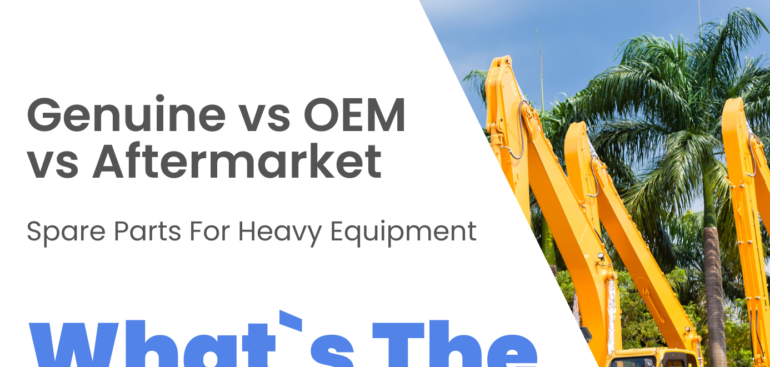
Genuine, OEM, Aftermarket Spare Parts – What’s The Difference?

Genuine, OEM, Aftermarket Spare Parts – What’s The Difference

Genuine, OEM, Aftermarket Spare Parts - What's The Difference?

The Difference Between Genuine, OEM and Aftermarket Heavy Equipment Parts

In the heavy duty equipment industry, the type of components utilized significantly impacts your machinery’s performance, lifespan, and overall operating costs. Generally, there are three categories of parts available – Genuine, OEM, and aftermarket. Each type carries its own unique advantages and disadvantages. Let’s dive deeper to understand the differences.

What Are Genuine Parts?

Genuine parts, also referred to as OE or original equipment, are similar in principle to OEM as they’re also made by the original equipment manufacturer. The primary differences between the two are that they were originally supposed to be installed on new equipment and carry the branding, logo and packaging of the manufacturer. As such, you receive an authentic part which was built with the intention of being initially installed into the vehicle.

Pros of genuine parts

The main benefits of genuine heavy equipment spare parts are authenticity, quality and safety. While they come at a premium, a manufacturer-produced part is certain to keep the machine in pristine condition. Much like OEM parts, they also benefit from fitting perfectly in the vehicle.

Cons of genuine parts

Genuine parts are usually the costliest of the three options. However, the increased quality has the potential to lower total costs in the long run, as they’re guaranteed to maintain the performance levels of the original parts. When assessing whether genuine parts are right for your needs, it’s worth comparing against similar OEM parts to see whether the extra cost is worth it in terms of quality and length of use.
What Are Genuine Parts


What Are OEM Parts?

Original Equipment Manufacturer (OEM) parts are produced by the same manufacturer that built the original parts for the equipment maker but do not carry the equipment maker’s logo. OEM parts maintain the same quality as genuine parts and are identical in terms of fit, performance, and reliability. The primary difference lies in the branding and potentially the price, as OEM parts can be slightly cheaper.

Pros of OEM Parts

Guaranteed Compatibility: As OEM parts are identical to the original ones, you can rest assured they will perfectly fit your machine.

Quality Assurance: OEM parts have to meet the manufacturer’s strict quality standards, providing an assurance of quality and durability.

Cons of OEM Parts

Higher Cost: OEM parts tend to be more expensive than aftermarket alternatives because they carry the brand name and quality assurance.

Limited Choice: When it comes to OEM parts, there’s usually just one option – the original part from the original manufacturer.

What Are Aftermarket Parts?

Aftermarket parts are produced by a company other than the original equipment manufacturer. These parts are designed to function the same as OEM or genuine part ones but their quality and specification are a bit lower and they don’t carry any known brands.

Pros of Aftermarket Parts

Cost-Effective: Aftermarket parts are generally less expensive than OEM parts, providing a cost-effective solution, especially for older machines where parts can be hard to find.

Variety: As aftermarket parts are produced by various manufacturers, it offers a wider variety of options to choose from.

Availability: Aftermarket parts are usually more readily available than OEM parts, reducing equipment downtime.
What Are Aftermarket Parts

Cons of Aftermarket Parts

Quality Variances: As multiple companies produce aftermarket parts, the quality can vary between manufacturers.

Overwhelming Choices: With so many options available, choosing the right aftermarket part can be challenging without adequate knowledge or expert help.

Sintra’s Approach

At Sintra Middle East, we have one goal in mind: to offer a solution that perfectly fits your needs. We understand the importance of both quality and cost-effectiveness. That’s why we provide tailored solutions for any spare part needs, be it Genuine, OEM or aftermarket replacement parts.

Conclusion

While there are pros and cons to all three categories of spare parts, the key lies in finding a reliable source that guarantees quality and value. Sintra Middle East stands by the promise of delivering superior quality spare parts for your heavy equipment. When you choose Sintra, you’re choosing durability, performance, and outstanding service, every time.

Whether you’re maintaining an entire fleet or a single machine, we’re here to ensure your heavy equipment runs efficiently, with the best parts on the market.

We hope you enjoyed your reading.

Sintra Middle East

We are part of your performance!

Give us a call at +97142498726 or send us an email at info@sampledemolinkurl.online, and we`ll take it from there!
How To Choose The Right Supplier

How to choose the right supplier for genuine spare parts

Important factors (the 4Qs) to consider when choosing a supplier for genuine spare parts

After-sales support is one of the most critical operations in the Heavy Equipment Industry and in most cases its successful implementation will be the basic customer decision factor for additional equipment purchases.


Finding a reliable spare parts supplier who can provide the necessary quality and address your business needs during the procurement process might be difficult and complicated.


A trustworthy Supplier should be able to effectively manage the complete procurement work for your industrial operation that includes but not limited to: sourcing spare parts, following up on orders and the Back-Ordered items, conducting a quality control before shipment, delivering to customer’s location, handling the export formalities, settling invoices and credit notes, processing warranty claims etc.


There are 4 key factors i.e., the 4Qs, that should be carefully considered when evaluating potential suppliers for Genuine parts:


Supplier Quality

Supplier’s employees and management need to have an extensive knowledge within the field of spare parts, to understand customer needs, and propose tangiblesolutions to their pain points which are usually related to poor inventory management and the lack of ability to distinguish between Genuine and Aftermarket (Non-Genuine) parts.

Besides, suppliers should also be able to act as specialized consultants who can quickly assist customers in developing and executing effective plans for their parts operations.


To take just a simple example: Recently, a purchasing officer from a Construction Company was urgently looking to get a fuel pump for an excavator. At that time, the fuel pump was out of stock worldwide, so asked the supplier’s sales person to check for an alternative option i.e., the respective Reman pump.  There is nothing more to say since the sales person did not know what Reman was..


Product Quality

On every construction site, there is a wide range of heavy equipment being used for different applications. These machines play a critical role in the success of every project and their smooth operation is directly connected with an increased productivity.

Relying on Genuine Parts is the best way to ensure the long life of the equipment as the quality guarantees to perform exactly as promised, without causing issues with equipment’s operation and providing peace of mind.


Moreover, from a financial perspective, the amount that can be saved upfront using non‑genuine parts is likely to cost a lot more in the near future, once these parts fail or perform at a lower level than expected.


There are numerous examples in our industry referring to aftermarket parts that were not fully compatible with the given equipment and even more cases have been reported related to warranty claims that never got responses or conclusive feedback.

Customer Service Quality

Customer service is another important factor to strengthen the relationship with customers at all levels, and each interaction is expected to be a positive experience. A positive customer service experience will likely encourage repeat business and enhance customer loyalty.

Customer service teams should carefully listen to their customers’ needs and enable continuing support during the challenging conditions that the spare parts industry is experiencing. Stock availability and lead time are the most common inquiries received from customers. Feedback should be precise and always correspond to the actual situation.

In this respect it is noted that, suppliers who receive an inquiry from a new prospect become over excited which leads to providing incorrect information.

Spare parts quotes generated from suppliers should include the minimum amount of data such as P/N, Description, Price, Quantity, Weight, Lead Time, Superseded P/N, Incoterms, Payment Terms and Offer Validity.

Finally, customer service response time is the most important way to ensure a great customer experience. Unfortunately, many companies struggle with their response times, that is, if they even respond at all. It turns out that 62% of suppliers do not even respond to customer service emails, ignoring them altogether. When they do respond, the average response time is ranging between 6 to 24 hours.

Imagine the maintenance manager of a mining company contacts supplier’s customer service to ask about the availability of the consumables required for the next planned maintenance of his Dozer. If that customer has to wait 24 hours to have their inquiry answered, then it is likely they will avoid contacting this supplier in the future.

Logistic Quality

After the sales process is completed, payments received, quality control is done, and the goods are available at the supplier warehouse then, the shipment should be shipped to the customer. This is the point where most suppliers fail to provide the expected service for various reasons resulting in shipping delays. Here are just a few examples:


• Incomplete Invoices without stating HS codes and Country of Origin;

• Incomplete Packing Lists without stating the Gross and Net Weight;

• Failing to issue Certificate of Origin;

• Failing to issue the export documents i.e, EXA etc;

• Failing to book the flight (Air freight) or Vessel (Sea freight);

• Failing to issue correctly the AWB or Bill of Landing (BL);

• Failing to comply with the Certified pallet/boxes requirements for export;


The importance of working with the supplier who is also able to handle the logistics process from A to Z should not be overlooked especially, during this period in which the ongoing supply chain challenges and high inflationary costs are an integral part of our business.


Our mission is to provide unparalleled consultative sales and service experience for construction equipment owners, contractors and fleet managers across MENA, seeking to enhance after-sales services.


We hope you enjoyed your reading!


Sintra Middle East

We are Part of Your Performance

Give us a call at +97142498726 or send us an email at info@sampledemolinkurl.online, and we’ll take it from there!